
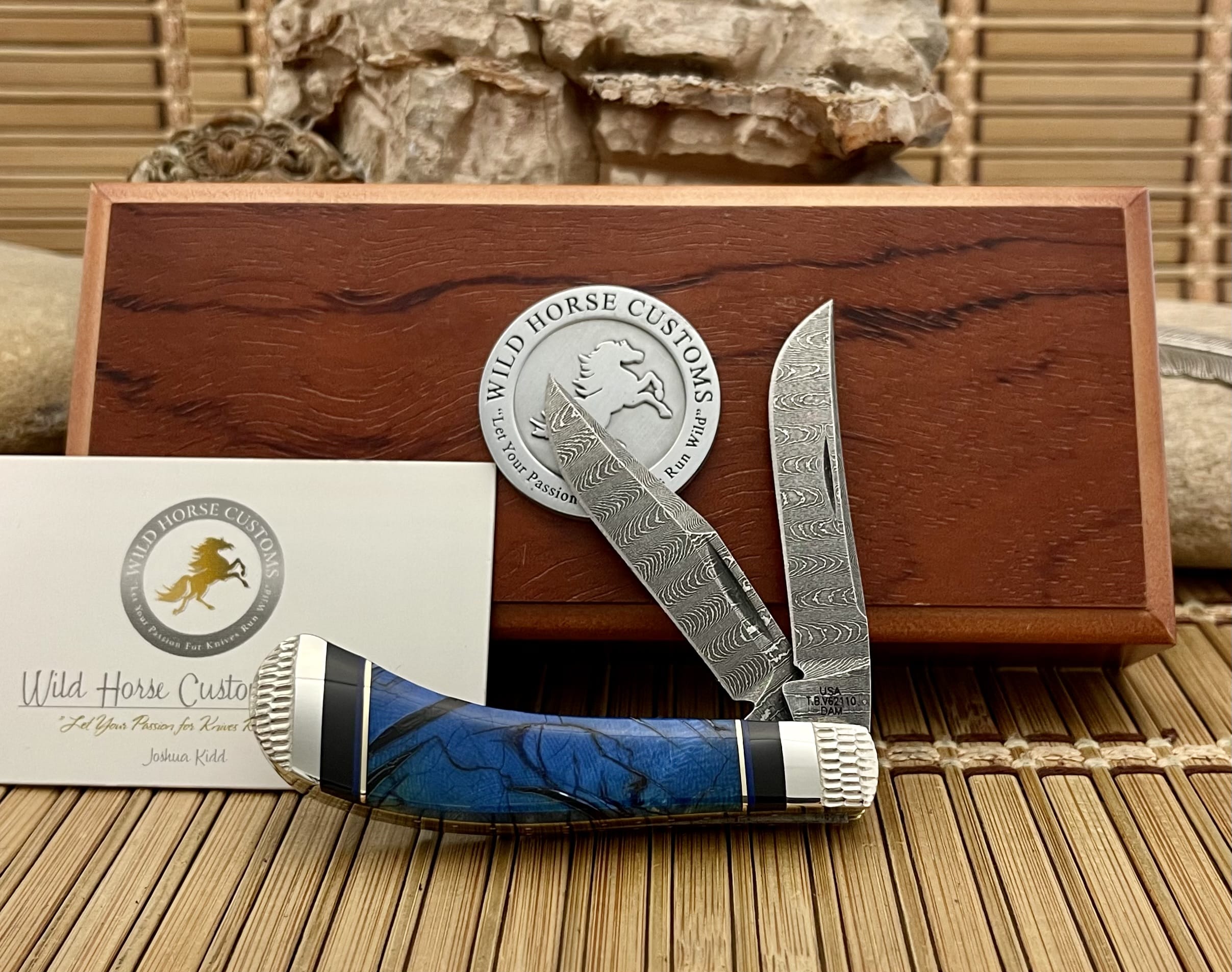
Discover Exquisite Damascus Steel Knives & Custom Artistry
Discover the legendary beauty and cutting performance of a Damascus pocket knife, meticulously finished by Wild Horse Custom for discerning collectors. This guide covers patterns, care, and buying tips for your next Damascus steel knife, view our newest custom Damascus knives below.
-
COLLECTOR’S Case XX Sod Buster Jr Pocket Knife – Deep Canyon Burnt Natural Bone – Damascus Steel
$179.99 Add to cart -
COLLECTOR’S Case XX Folding Hunter Pocket Knife – Deep Canyon Burnt Natural Bone – Damascus Steel
$314.99 Add to cart -

COLLECTOR’S Case XX Mini Trapper Pocket Knife – Deep Canyon Burnt Natural Bone – Damascus Steel
$243.99 Add to cart
The Legendary Craftsmanship Behind Every Damascus Blade Knife
For centuries, the captivating patterns of Damascus steel have symbolized strength, artistry, and mystery. Each Damascus knife is a unique masterpiece, forged from layers of contrasting steels, meticulously folded and manipulated to reveal mesmerizing waves, swirls, and intricate designs that are truly one-of-a-kind.
Beyond its striking aesthetic, a genuine Damascus steel knife offers exceptional performance, renowned for its resilience, edge retention, and the balance it brings to the hand. It’s an investment in a piece of history and a functional work of art.
Beyond the Blade: Your Custom Damascus Knife by Wildhorse Customs
At Wildhorse Customs, we elevate the inherent beauty of a Damascus blade knife into a personalized heirloom. While we meticulously select and source the finest genuine Damascus, our true passion lies in transforming these remarkable blades through unparalleled custom embellishments and artistry.
Find Your Perfect Damascus Knife
Browse our diverse range of Damascus steel knives, each selected for its quality and potential for personalization. From everyday carry to collector’s showpieces, discover the Damascus that speaks to you. View All Damascus Pocket Knives
The Art in Every Blade: Exploring Damascus Steel Patterns
The mesmerizing beauty of a Damascus blade knife isn’t just random; it’s the result of skilled manipulation, precise forging techniques, and the unique interaction of different steel alloys. Each pattern tells a story of the smith’s intentional artistry. While the possibilities are vast, here are some of the most sought-after and recognizable Damascus steel patterns you’ll encounter, each offering its own distinctive character:
Raindrop Damascus
- Appearance: As the name suggests, this pattern features a scattering of distinct circular or oval “drops” across the blade’s surface, resembling raindrops on a still pond. It offers a subtle yet captivating visual texture.
- How it’s Made: After the initial layers of steel are forge-welded and folded into a billet, the smith creates shallow indentations or “dimples” across the surface using a drill or a specialized hammer. When the billet is then forged flat and etched, these manipulated areas react differently to the acid, revealing the characteristic circular patterns. The size and spacing of the dimples determine the final look.
- Why it’s Prized: Raindrop Damascus is often chosen for its elegant, understated beauty and the serene, organic feel it brings to a Damascus knife. It’s a popular choice for both functional and collectible pieces.
Ladder Damascus
- Appearance: This pattern is characterized by distinct, parallel lines running perpendicular to the blade’s edge, resembling the rungs of a ladder. It’s clean, structured, and offers a strong sense of direction and contrast.
- How it’s Made: After creating a multi-layered billet, the smith forges or grinds a series of uniform grooves across the billet’s surface. When the steel is then drawn out and forged to shape, these grooves cause the internal layers to buckle and flow in a way that, upon etching, reveals the linear “ladder” effect. The depth and spacing of the grooves directly influence the boldness of the pattern.
- Why it’s Prized: Ladder Damascus highlights the layered construction of the steel with striking clarity. It’s favored by those who appreciate precision and a strong, defined aesthetic.
Twist Damascus
- Appearance: One of the most classic and recognizable patterns, Twist Damascus features elegant, spiraling, rope-like swirls that flow along the length of the blade. The twists can range from bold, wide spirals to tight, intricate coils.
- How it’s Made: A multi-layered steel billet is forged into a square or round bar. While hot, the smith grasps the bar and twists it along its longitudinal axis. The amount and tightness of the twist dictate the resulting pattern. After twisting, the bar is then forged flat into the blade shape, stretching and revealing the mesmerizing spirals when etched.
- Why it’s Prized: Twist Damascus offers a dynamic, flowing aesthetic that can make a Damascus pocket knife or a larger Damascus hunting knife truly stand out. It showcases the malleability and artistic potential of the layered steel.
Feather Damascus
- Appearance: Arguably one of the most intricate and visually striking patterns, Feather Damascus features a central “spine” line with elegant, curling “fronds” radiating outwards, resembling a feather. It’s a highly sought-after and complex design.
- How it’s Made: This pattern requires advanced forging techniques. It often starts with a multi-layered billet that is cut longitudinally or manipulated with a specific “W” shape. The billet is then split down the middle with a dull wedge, causing the layers to stretch and deform. When these two halves are rejoined and forged flat, the stretched layers create the distinct feathery appearance upon etching.
- Why it’s Prized: Feather Damascus is a testament to the bladesmith’s mastery. Its complexity and stunning visual appeal make it a premium choice for high-end collector’s pieces, custom display knives, and those who seek the pinnacle of artistry in a Damascus Knife.
For a even deeper look into the different types of Damascus, check out, this article by The Cooking Guild
Damascus Knife FAQ
Quick answers on modern Damascus, pattern types, daily carry, and care. If you’re new to Damascus, start here.
Is Damascus steel real and how is it made today?
Yes. Modern Damascus is pattern-welded steel: two or more steels are stacked, forge-welded, folded/twisted, then ground so the layers show. An acid etch reveals the contrasting pattern. Performance depends on the steels used and the heat treat, not just the pattern itself.
What are raindrop, ladder, twist, and feather patterns?
Raindrop: shallow holes/dimples are drilled or dimpled into the billet, then flattened—creating circular “raindrops.”
Ladder: parallel grooves are ground/cut into the billet and flattened, forming a rung-like pattern.
Twist: the bar is literally twisted along its length, producing spirals that flow toward the tip.
Feather: the billet is split and re-forged to create a mirrored “quill/feather” effect down the centerline.
Does a Damascus blade rust? How do I care for it?
Many Damascus blades use high-carbon steels and can rust if neglected; stainless Damascus resists corrosion better but still needs care.
Wipe dry after handling; avoid prolonged moisture or acids.
Apply a light coat of mineral oil or a silicone cloth to the blade; a drop of oil at the pivot on folders.
Store dry (you can even add a silica gel pack); avoid abrasive pads that can flatten the etched pattern.
Is a Damascus pocket knife good for daily carry?
Absolutely—if the maker’s steel choices and heat treat are solid. A Damascus pocket knife can offer excellent edge retention and toughness; choose stainless Damascus for lower maintenance. Expect normal patina/micro-wear from EDC. If you want a showroom finish long-term, reserve it for lighter use and regular wipe-downs.
How do I verify a genuine Damascus blade?
Look for pattern continuity (visible on spine/tang/choil—not just the flats), fine relief you can feel after etching (not a printed decal), and natural variation rather than a perfectly repeating print. Buy from reputable sellers and makers, and ask for documentation.